
Searching Quitman County Civil Dockets
Superior civil cases start with the Georgia E-Access provider directory. Find the Quitman Superior Court row there. It points to PeachCourt, which requires an account. Once signed in, PeachCourt lets you choose Case Search. You can pick the county and court, then look up a case by exact case number or party name. Search Cases is the right tool for a docket lookup. Search Filings does a different job, so do not mix them up. Quitman publishes no case-number format, so copy every digit, dash, and leading zero exactly. Name searches can pull false matches. Check the court, caption, filing date, and status before trusting a hit. A blank result does not close the door. The case may sit on paper, be restricted, be brand new, or fall outside the vendor's coverage. Call the right office instead of giving up.
- Identify Superior or Magistrate Court.
- Use Georgia E-Access for the Superior provider.
- Select Quitman County and the right court in PeachCourt.
- Search the exact number or party name.
- Open the case and verify the needed filing with the clerk.
Quitman Civil Courts Compared
Georgia runs six classes of trial court. Quitman's own sources name four: Superior, Juvenile, Probate, and Magistrate. Superior Court carries broad civil power and exclusive jurisdiction over divorce. The local clerk's page counts divorces, child support, adoptions, and liens among its civil records. Magistrate Court, meanwhile, hears civil claims up to $15,000. It also handles dispossessory actions, garnishments, returned-check processes, and other matters the county lists.
| Court | Common civil work | Access start |
|---|---|---|
| Superior | Broad civil, divorce, domestic relations, liens | PeachCourt or Superior clerk |
| Magistrate | Claims up to $15,000, garnishment, possession cases | Probate/Magistrate office |
| Juvenile | Protected juvenile matters | Direct court inquiry under access rules |
| Former Municipal | No current Georgetown court | Work transferred to Probate or Magistrate |
The Georgia court-class overview supplies statewide context. Quitman's local sources control the actual routing.
Inside a Quitman County Civil Docket
Think of a civil docket as the timeline, not the whole file. Entries can cover the case number, caption, filing date, the complaint or petition that opened the case, service, the answer, motions, hearings, orders, judgment, costs, and enforcement. PeachCourt's exact labels sit behind a login. Keep two cautions in mind. An entry can appear with no document image attached. And a downloadable image is not the same as a certified copy.
| Caption | The formal case title. Do not rewrite it. |
|---|---|
| Complaint or petition | The filing that begins the claim; its statements are allegations. |
| Service | The record of delivery or attempted delivery, not a ruling. |
| Motion | A request for court action, not the court's decision. |
| Order or judgment | The court's entered ruling; check whether it is final or later changed. |
Read forward from the first filing. Separate what a party requested from what the judge actually ordered. A garnishment, payment, service return, or FIFA entry is just a procedural step, not a merits judgment.
Quitman Magistrate Docket Counter
The official Probate/Magistrate page names Judge L. Matthew Self and Chief Clerk Julia Floyd. It also lists the phone, 229-334-2224, and the P.O. Box 7 mailing address. No separate Magistrate docket portal appears there. Call the clerk for the current procedure to view a Quitman County court docket. Ask also how to order a copy, confirm a hearing, or file paper the court accepts by mail.
Probate and Magistrate work shares one office, yet the records stay with their court class. A civil docket for a Superior Court divorce or a lien filing does not belong at this counter. The matter is civil, but the court class controls where it sits. Give the clerk your case number and case type. Then ask where that court record actually sits.
The Probate/Magistrate page lists the local jurisdictions the court covers along with its published fee list. Check it before mailing a records request or a filing to P.O. Box 7.
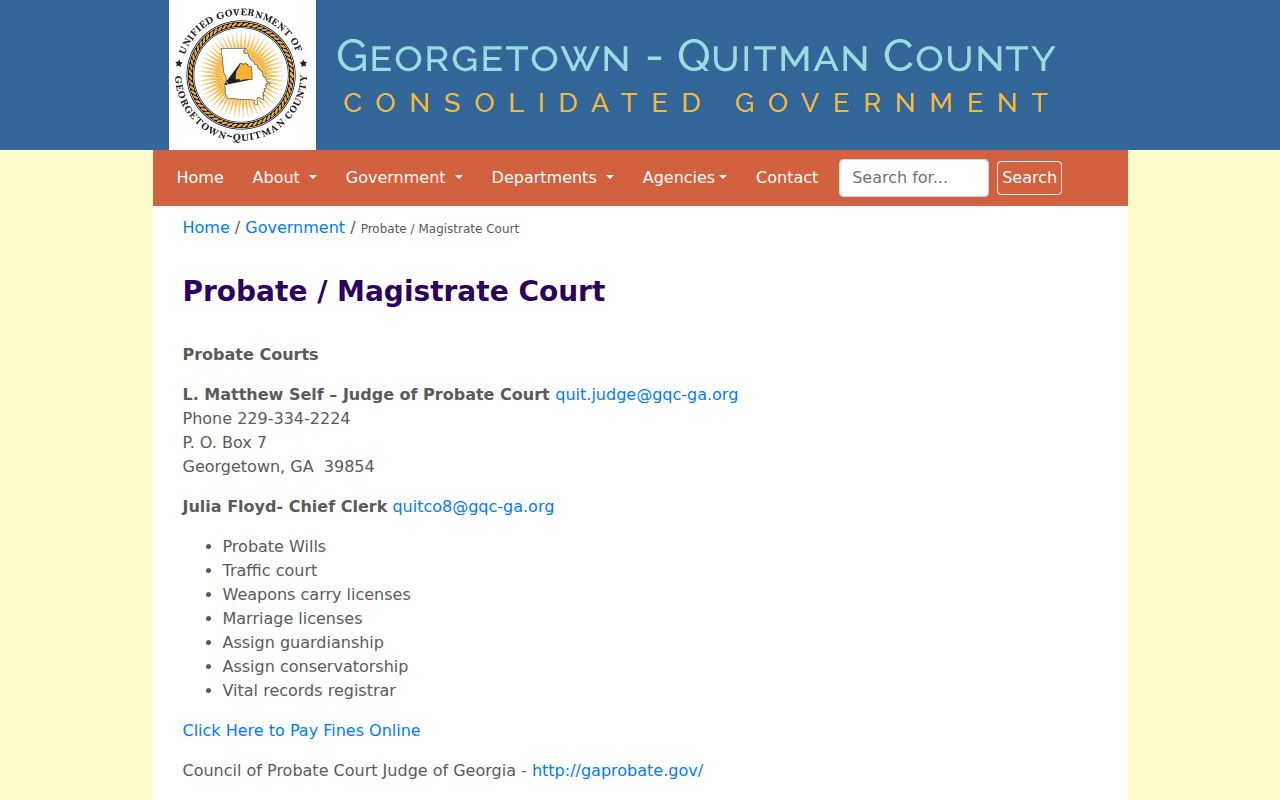
The page gives the best local starting point for Magistrate civil docket questions.
Civil Case Types on the Docket
Quitman Superior civil dockets can carry general civil disputes and divorce and domestic relations. Child-support matters, adoption-related files, and liens appear too. Access varies inside those groups. Family and adoption material may be restricted even though the case is civil. Magistrate dockets may include ordinary civil suits and dispossessory actions. Garnishments, returned checks, foreclosure of personal property, and service events show up there as well. "Civil" does not mean every page is open. A public docket shell can exist. An exhibit, a protected identifier, or a whole document may stay withheld. Juvenile-related records answer to separate rules. Ask the custodian what can be inspected and whether a redacted copy is available.
- Pleadings state claims and responses.
- Service entries track delivery of process.
- Motions ask the court to act.
- Settings schedule hearings or trials.
- Orders and judgments record judicial action.
Quitman Civil Filing Costs
The county publishes specific Magistrate filing and service amounts. Treat them as planning figures, not a full civil court cost schedule. Confirm the total before you file, because added defendants, later service, amendments, or other court costs can push the number up.
| Quitman Magistrate action | Published amount |
|---|---|
| Civil suit with Sheriff's service | $115.00 |
| FIFA | $9.00 |
| Dispossessory action with Sheriff's service | $101.00 |
| Service per civil defendant, including writ of possession | $50.00 |
| Garnishment | $101.00 |
| Foreclosure of personal property | $101.00 |
| Subpoena service | $10.00 |
The local page says applicable actions and service fees go to Magistrate Court of Quitman County. It sets no clerk copy or certification charge.
Civil Docket Settings and Hearings
A setting is a scheduled event, nothing more. Civil dockets may list motion hearings, status conferences, pretrial events, trials, or labels particular to the court. Write down the date, time, court, judge, location, and setting type. Then confirm close to the event. A continuance shifts a setting; a cancellation removes it. Neither means the case was dismissed. The Pataula public month calendar spans seven counties but offers no full searchable Quitman setting table. Use the case docket and the clerk alongside it. The dedicated Quitman County court dates resource explains the circuit calendar and emergency-order checks. Note: Ask whether the hearing is in person, by video, or hybrid, since a public calendar label may not answer that.
Quitman Civil E-Filing Boundary
Quitman Superior Court runs its civil filings through PeachCourt. The Georgia e-file chart marks it mandatory for this court. PeachCourt walks an authorized filer through a set sequence. Pick the party, pick the document type, upload a PDF. Then choose e-service, pay, confirm redaction, and submit. Attorneys and other approved filers use that workflow. It is not how the public reads a Quitman County civil docket.
The cost side matters to filers. PeachCourt lists a $30 per-party civil e-filing fee covering ten filings. Later filings cost $5 where it applies. Convenience costs from the vendor sit on top, and separate court fees may also apply. Someone who just wants to view a docket entry or buy a document should stay out of the filing screens entirely.
Key distinction: Case Search locates the record, e-filing adds an authorized paper, and a clerk request seeks an official copy.
Civil Docket Access Rules
Georgia court records are generally open to the public. A law or a court process can close them, though. They are not ordinary agency records. Under the Attorney General's court-record FAQ, Superior, Probate, and Magistrate records do not fall under the Open Records Act the way executive-agency documents do. So skip the agency-request mindset. Ask the clerk or the court itself for access. Do not assume an agency deadline controls the answer.
Uniform Superior Court Rule 21 sets out the public-access rule. It also covers the procedure for restricting material. Filers must redact protected identifiers. Adoption, juvenile, sealed, and other protected files can call for special handling. One caution for docket searches: a portal result that comes back blank does not prove no case exists.
Verify Quitman Civil Docket Records
PeachCourt may not yield the document you need. In that case, call Rebecca Fendley's Superior clerk office at 229-334-2578. Ask two things up front. Is the file paper or scanned? Can you inspect it, get it by mail, or use another route? For Magistrate matters, call 229-334-2224 instead. Email, fax, drop box, and mail acceptance are not confirmed for every record type. So check before sending anything.
Request certification only if the receiving office or your purpose demands it. A portal image is not automatically a certified copy of a Quitman County court record. When you contact the clerk, state the case number, the exact document, and the date range. Then ask about cost, payment, turnaround, and delivery. The clerk can quote current copy prices for Quitman Superior Court. A narrow, specific request reaches the right office faster and avoids misrouting.